
At Global Florida Realty, we know that understanding tax write-offs for rental properties can significantly impact your bottom line as a property owner.
Maximizing your deductions can lead to substantial savings, but it’s essential to know what you can claim.
In this post, we’ll explore both common and lesser-known tax write-offs for rental properties, helping you make the most of your investment.
Rental property owners can reduce their taxable income through several tax deductions. Understanding these deductions will help you maximize your returns on investment properties.
Mortgage interest often represents the largest deduction for rental property owners. You can deduct the interest paid on loans used to acquire, improve, or maintain your rental property. This includes interest on mortgages, home equity loans, and lines of credit used for rental property purposes. This itemized deduction allows homeowners to subtract mortgage interest from their taxable income, lowering the amount of taxes they owe.
Property taxes are fully deductible for rental properties. This includes taxes paid to local and state governments. You can only deduct the portion of property taxes that apply to the time the property served as a rental. If you used the property for personal use for part of the year, you’ll need to prorate the deduction accordingly.
All types of insurance premiums related to your rental property qualify as tax-deductible expenses. This includes landlord liability insurance, fire insurance, flood insurance, and even mortgage insurance premiums. We recommend reviewing your insurance coverage annually to ensure adequate protection while maximizing deductions.
Expenses for repairs and maintenance are fully deductible in the year you incur them. This includes costs for fixing leaks, repainting, replacing broken windows, or repairing appliances. The IRS defines repairs as expenses that keep your property in good working condition but don’t add value or prolong its life. (It’s important to distinguish between repairs and improvements, as improvements must be capitalized and depreciated over time.)
Depreciation allows you to deduct the cost of your rental property over its useful life. To be depreciable, property must have a useful life that extends substantially beyond the year you place it in service. This deduction can significantly reduce your taxable income, even if your property appreciates in value. (Note that depreciation recapture may apply when you sell the property, so consult with a tax professional to understand the long-term implications.)

The IRS requires documentation to support all deductions claimed on your tax return. Try to keep meticulous records of all expenses related to your rental property. This practice will not only help you maximize your deductions but also ensure compliance with tax laws.
As we move forward, let’s explore some lesser-known tax write-offs that landlords often overlook. These deductions can further reduce your tax liability and increase your rental property’s profitability.
Savvy landlords know that maximizing tax deductions extends beyond the obvious. Let’s explore some lesser-known deductions that can boost your rental property’s profitability.
If you manage your rental properties from a dedicated space in your home, you might qualify for a home office deduction. The IRS provides information on figuring and claiming the deduction for business use of your home. However, you must prove that this space serves regularly and exclusively for your rental business.
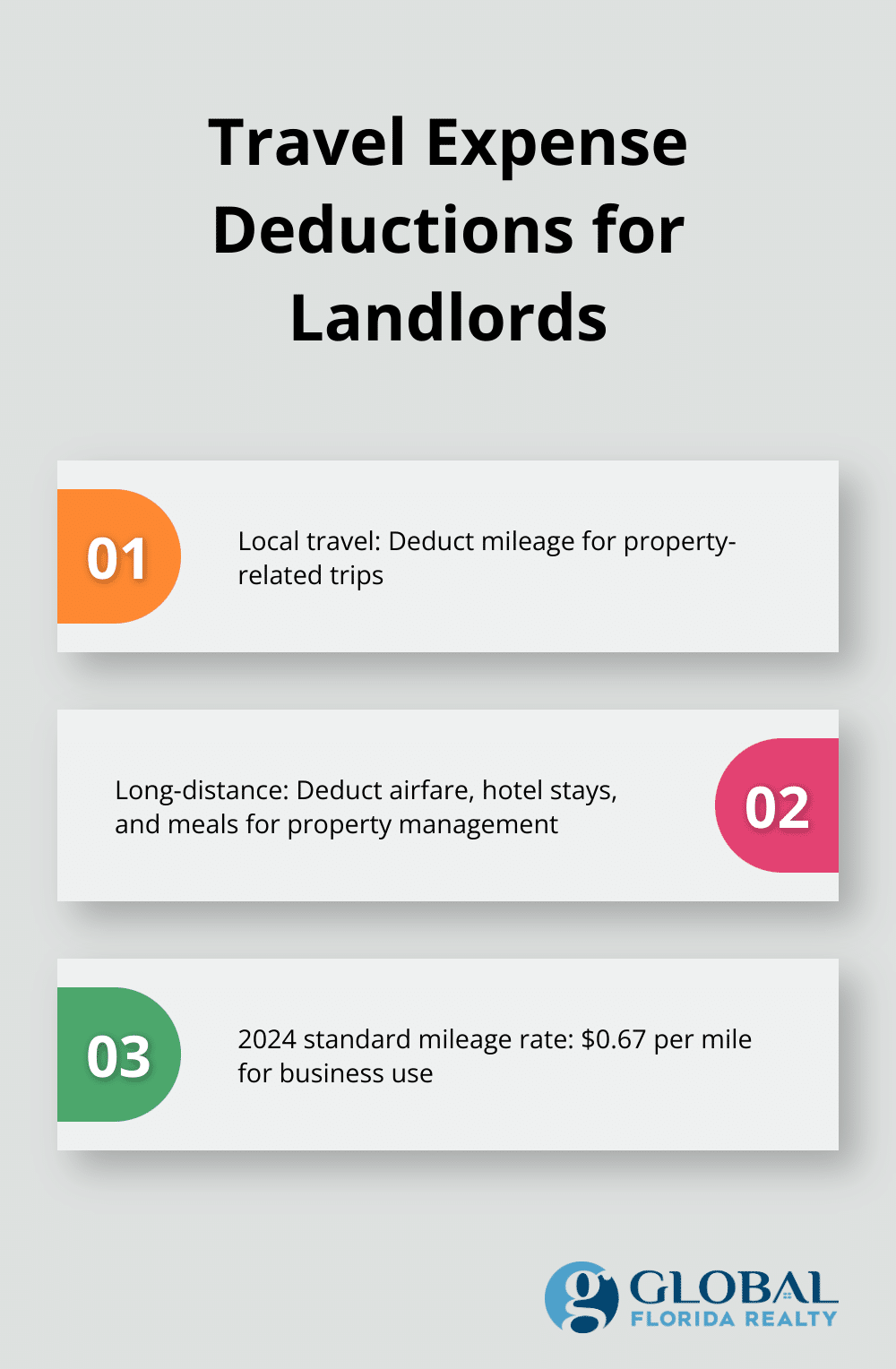
Many landlords overlook the deduction of travel costs related to their rental properties. This includes mileage for local trips to show properties, collect rent, or perform maintenance. For long-distance property owners, airfare, hotel stays, and meals during trips to manage rentals are deductible. For 2024, the standard mileage rate for the cost of operating your car for business use is 67 cents ($0.67) per mile. (Keep a detailed log of your trips, including dates, mileage, and purpose, to support these deductions.)
Legal and professional fees often go unnoticed as write-offs. Fees paid to attorneys, accountants, or property managers are fully deductible. Additionally, costs for education related to your rental business, such as real estate investment courses or landlord association memberships, can be written off.
Don’t overlook expenses related to advertising and marketing your rental property. This includes costs for online listings, print ads, professional photography, and even the creation and maintenance of a website for your rental business.
If you pay for any utilities or services for your rental property, these costs are deductible. This might include water, electricity, gas, trash removal, or even lawn care services. For short-term rentals, internet and cable TV expenses can also be deducted.
These lesser-known tax write-offs can substantially reduce your taxable income. Meticulous record-keeping and understanding IRS guidelines are essential to maximize these deductions. In the next section, we’ll explore strategies to optimize your rental property tax deductions and ensure you’re not leaving money on the table.
Accurate and detailed record-keeping forms the foundation of effective tax management. Use digital tools to track every expense related to your rental property. Apps like Quickbooks or Stessa help you categorize expenses, store receipts, and generate reports. This level of organization saves time during tax season and ensures you don’t miss out on any deductions.
The IRS treats repairs and improvements differently. Repairs maintain your property’s current condition and are fully deductible in the year you make them. Improvements, however, add value or extend the property’s life and must be depreciated over time. For example, fixing a leaky roof is a repair, while replacing the entire roof is an improvement. Understanding this distinction can significantly impact your tax strategy.
Consider more sophisticated tax strategies to maximize your deductions. Cost segregation studies can accelerate depreciation deductions by identifying and reclassifying building components that can be depreciated over shorter periods. While potentially complex, these engineering-based analyses can lead to substantial tax savings.
The Tax Cuts and Jobs Act introduced a 20% deduction on qualified business income for eligible rental real estate activities. This deduction can significantly reduce your taxable income. However, you must meet specific requirements to qualify, including maintaining separate books and records for each rental property.
Tax laws change frequently. What worked last year might not be optimal this year. We at Global Florida Realty always recommend consulting with a tax professional who specializes in real estate. They can provide personalized advice tailored to your specific situation and help you navigate complex tax regulations.
Professional property management services (like those offered by Global Florida Realty) can help you optimize your tax strategy. These experts stay up-to-date with the latest tax laws and can identify deductions you might overlook. They also maintain detailed records of all property-related expenses, which proves invaluable during tax season.

Tax write-offs for rental properties play a vital role in maximizing investment profitability. Property owners must understand common deductions like mortgage interest and property taxes, as well as lesser-known write-offs such as home office expenses and travel costs. Proper documentation serves as the foundation for a successful tax strategy, ensuring compliance with IRS regulations and helping capitalize on every available deduction.
Strategic tax planning involves more than claiming deductions. Property owners need to stay informed about changing tax laws, understand the differences between repairs and improvements, and explore advanced strategies like cost segregation studies. These approaches can lead to significant tax savings and improved cash flow for rental businesses.
At Global Florida Realty, we understand the complexities of rental property taxation and the importance of maximizing returns. Our team of experts can guide you through the intricacies of real estate investment (from property acquisition to tax optimization). For personalized assistance with your real estate investments and to learn more about optimizing your tax strategy, visit Global Florida Realty.