
At Global Florida Realty, we understand the importance of maximizing returns on rental property investments. One key aspect of this is understanding rental property depreciation rates.
Depreciation can significantly impact your tax liability and overall profitability. In this post, we’ll break down the process of calculating depreciation rates for your rental properties, helping you make informed decisions about your real estate investments.
Rental property depreciation serves as a powerful tax tool for real estate investors. It allows you to recover the cost of business or income-producing property through deductions for depreciation, which reduces your taxable income and can potentially save you thousands of dollars each year.
When you purchase a rental property, you invest in both a building and the land it occupies. The IRS considers buildings to wear out over time, while land maintains its value. Depreciation accounts for this wear and tear.
The IRS permits you to deduct a portion of your property’s value each year for 27.5 years for residential properties or 39 years for commercial properties. This deduction applies to your rental income, effectively lowering your tax bill.
Not all properties qualify for depreciation. To be eligible, a property must meet several criteria:
Most rental properties, including single-family homes, multi-family units, and commercial buildings, are eligible for depreciation. However, vacant land cannot be depreciated because it doesn’t wear out over time.
Understanding and properly applying depreciation can significantly boost an investor’s returns. For example, if you purchase a residential rental property for $200,000 (excluding land value), you could potentially deduct about $7,273 per year from your taxable rental income.
This deduction can make a substantial difference in your after-tax profits, especially when combined with other allowable expenses (such as mortgage interest, property taxes, and maintenance costs).
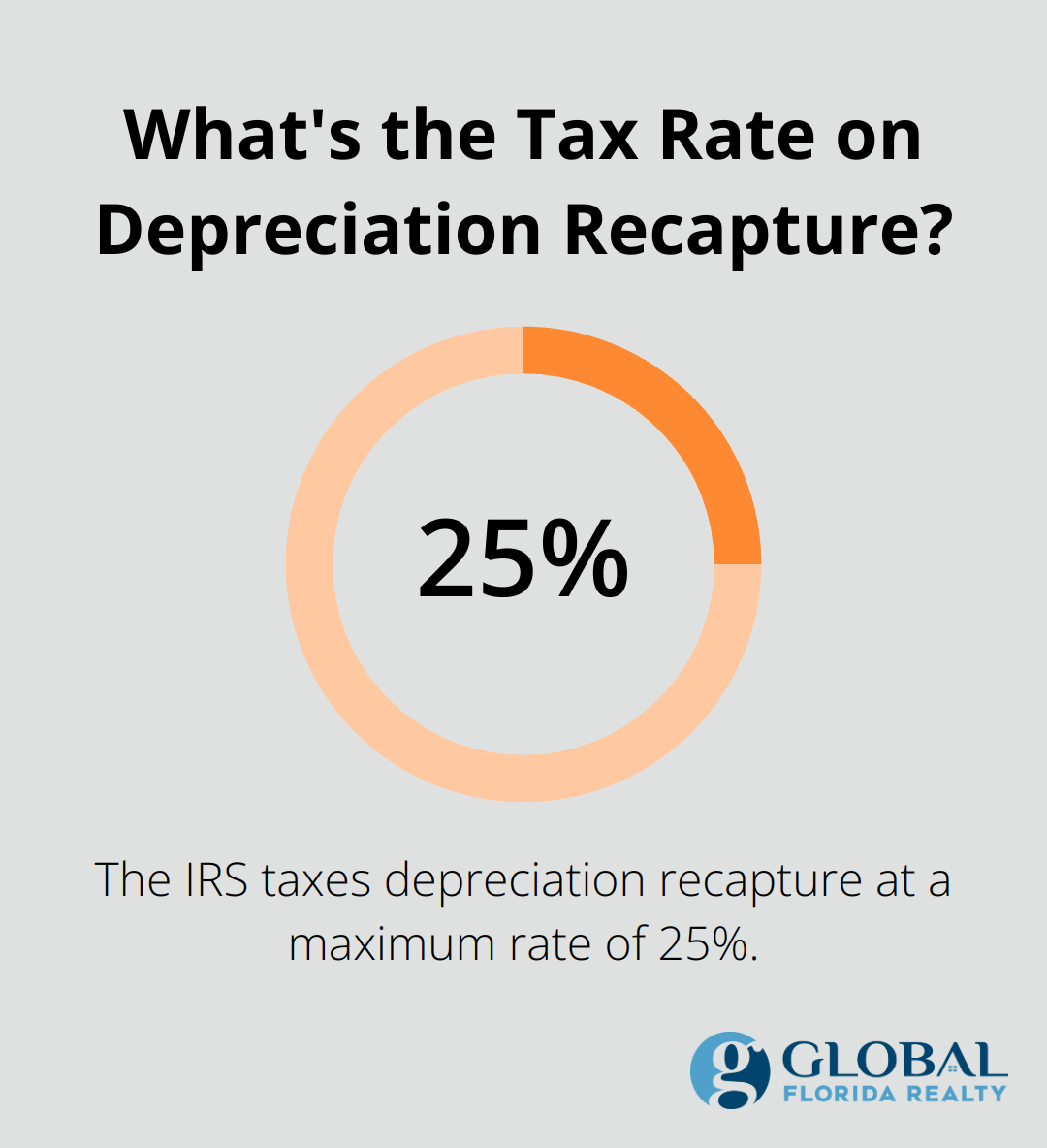
It’s important to note that depreciation isn’t a free pass. When you sell the property, you’ll need to recapture the depreciation you’ve claimed over the years. Depreciation recapture both increases the potential gain on your property and the rate at which a portion of the gain will be taxed. The IRS taxes this recaptured amount at a maximum rate of 25%, which is still lower than many investors’ ordinary income tax rates.
Understanding rental property depreciation plays a key role in maximizing your real estate investment returns. However, tax laws can be complex and change frequently. We always recommend consulting with a qualified tax professional to ensure you apply depreciation correctly and take advantage of all available tax benefits.
Now that we’ve covered the basics of rental property depreciation, let’s move on to the specifics of calculating depreciation rates.
The IRS uses the Modified Accelerated Cost Recovery System (MACRS) to determine how you should depreciate your rental property. For property placed in service after 1986, you generally must use MACRS. This system provides a standardized method for calculating depreciation across different types of assets, including real estate.
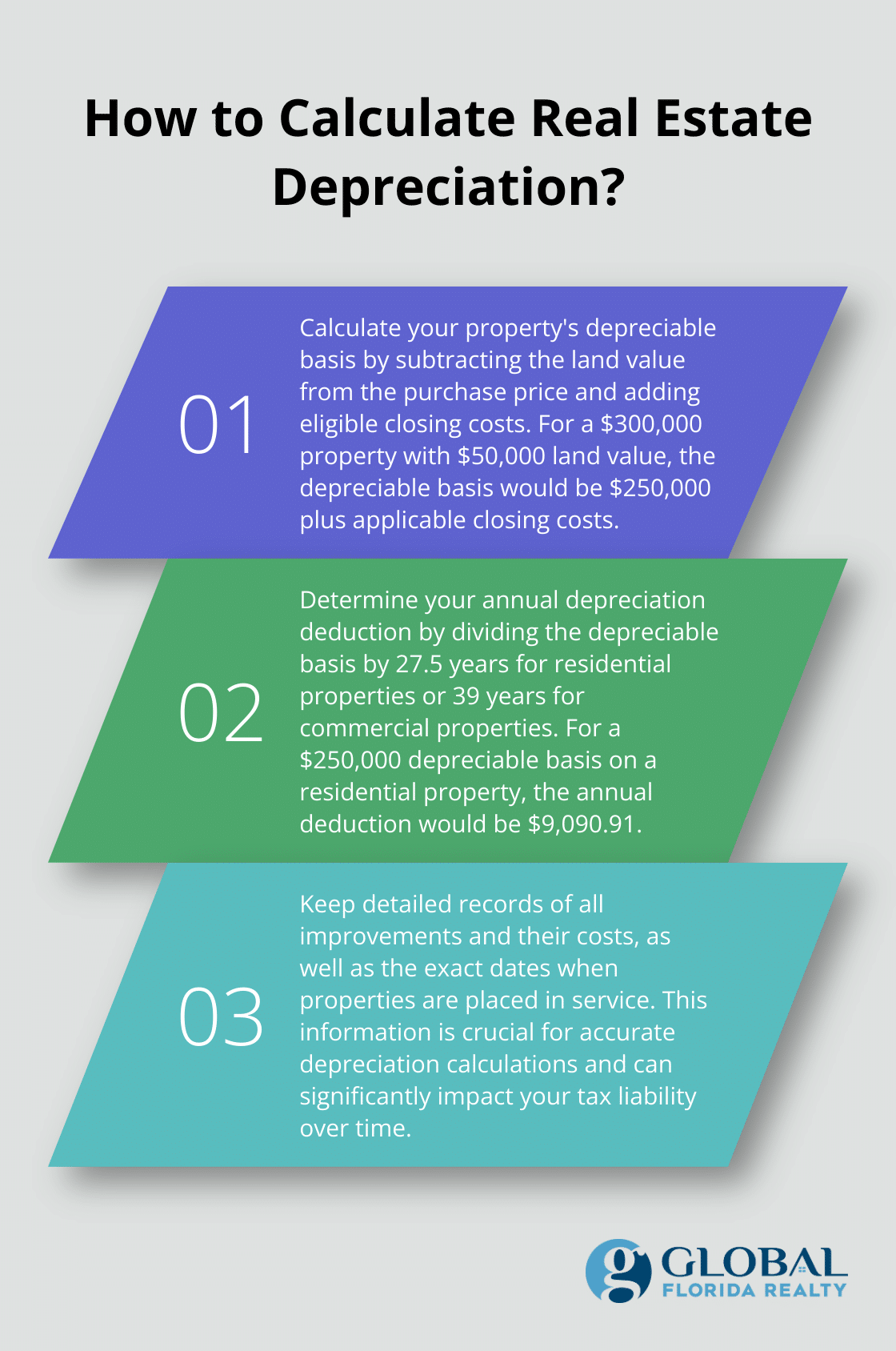
The first step in calculating depreciation involves determining your property’s depreciable basis. This is not simply the purchase price of the property. Instead, it’s the purchase price minus the value of the land, plus certain closing costs and improvements.
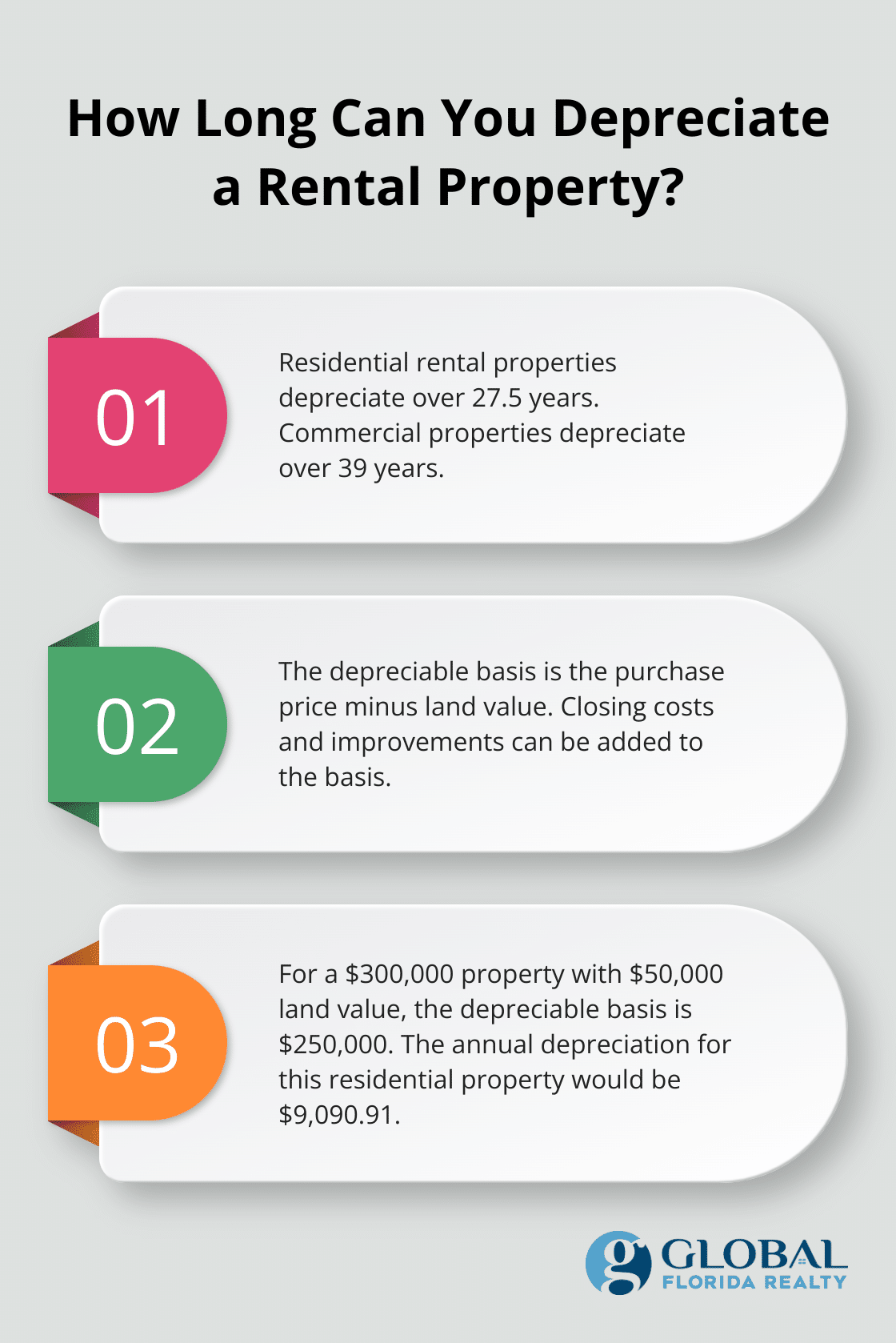
For example, if you bought a rental property for $300,000, and the land is valued at $50,000, your depreciable basis would be $250,000. You should add to this any closing costs that are considered part of your basis (such as title fees, recording fees, or transfer taxes).
Once you’ve determined your depreciable basis, you’ll apply the MACRS depreciation method. For residential rental properties, the depreciation period is 27.5 years. For commercial properties, it’s 39 years.
To calculate your annual depreciation deduction, divide your depreciable basis by the appropriate number of years. Using our previous example of a $250,000 depreciable basis for a residential property:
$250,000 / 27.5 years = $9,090.91 per year
This means you can deduct $9,090.91 from your taxable rental income each year for 27.5 years.
If you didn’t own the property for the full year when you started renting it out, you’ll need to prorate your depreciation for that first year. The IRS provides specific percentages to use based on which month you placed the property in service.
For instance, if you started renting out a residential property in July, you’d multiply your annual depreciation amount by 3.485% for that first year. In our example, that would be:
$9,090.91 * 0.03485 = $316.82
This prorated amount would be your depreciation deduction for the first year.
While these steps provide a general guide, individual situations can vary. The complexities of tax law and the potential for significant financial impact make it essential to consult with a qualified tax professional. They can help you navigate these calculations and ensure you’re claiming depreciation correctly for your specific rental property investments.
As we move forward, let’s explore the various factors that can affect your depreciation calculations and how to account for them in your investment strategy.
The separation of land value from the total property cost plays a significant role in depreciation calculations. The IRS does not allow depreciation on land because it does not wear out or become obsolete. You must determine the land value accurately to calculate your depreciable basis.
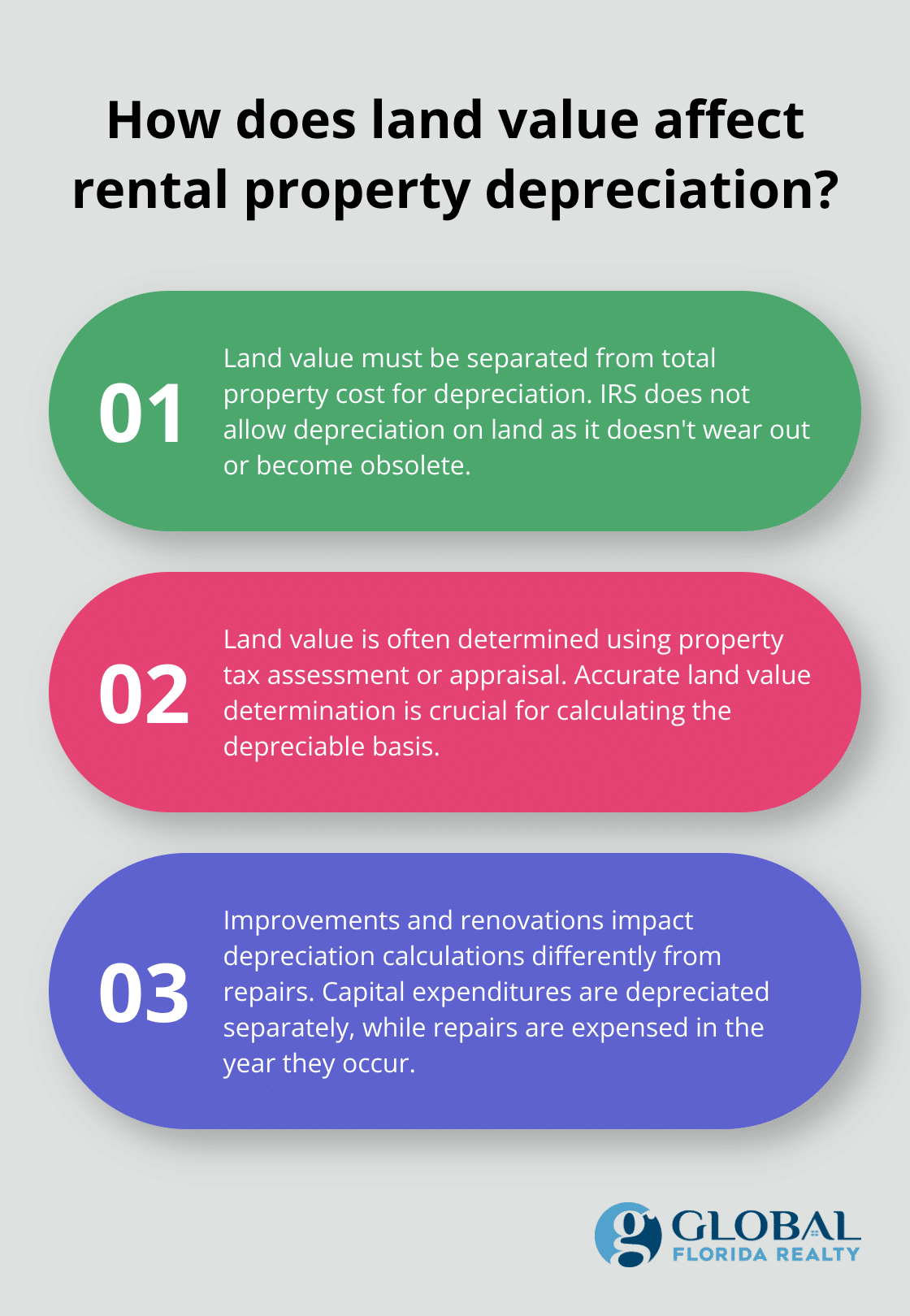
Since land is not depreciable, you must separate the land value from the building value. This is often done using the property’s tax assessment or an appraisal.
Improvements and renovations to your rental property can impact your depreciation calculations. These differ from regular repairs and maintenance (which are typically expensed in the year they occur). Improvements that add value to the property or extend its useful life are depreciated separately.
Repairs are like everyday patch-up jobs-stop the leaks and keep the property shipshape. These little fixes let you knock off the costs from your taxes that year.
The acquisition of a rental property or conversion of a personal property to a rental during the year requires accounting for partial-year depreciation. The IRS provides specific tables for calculating depreciation in the first and last years of service.
For residential rental properties, you use a mid-month convention. This means you treat the property as placed in service or disposed of in the middle of the month. If you started renting out a property in August, you could claim 4.5 months of depreciation for that first year.
Accurate record-keeping is essential for proper depreciation calculations. You should maintain detailed records of all improvements and their costs, as well as the exact dates when properties are placed in service. These details can make a significant difference in your tax liability over time.
Tax laws can be complex and change frequently. Working with a qualified tax professional ensures you calculate depreciation correctly and take full advantage of all available tax benefits for your rental property investments.
Rental property depreciation rates offer real estate investors a powerful tool to reduce tax liability and increase returns. The Modified Accelerated Cost Recovery System (MACRS) provides a standardized method for calculating depreciation, but investors must accurately determine their depreciable basis and account for factors like land value and improvements. Proper depreciation calculations allow investors to spread the cost of their investment over time, potentially freeing up funds for further investments or property improvements.
The complexities of rental properties depreciation rates require attention to detail and a thorough understanding of current tax laws. Meticulous record-keeping of all property-related expenses, improvements, and important dates proves essential for accurate calculations and potential audits. Professional guidance ensures investors maximize their depreciation benefits while remaining compliant with IRS regulations.
Global Florida Realty understands the importance of informed decision-making in real estate investing. Our team of experts can guide you through the intricacies of property investment, from finding the right rental properties to understanding the tax implications (including depreciation) of your investments. With our comprehensive services, we stand ready to help you navigate every aspect of your investment journey and set you up for long-term success in real estate investing.