
At Global Florida Realty, we often field questions about Florida capital gains tax on real estate. It’s a topic that can significantly impact your property investment decisions.
Understanding the ins and outs of capital gains tax is essential for anyone buying or selling property in the Sunshine State. This guide will break down the key aspects of capital gains tax in Florida and provide strategies to help you navigate this complex area of real estate finance.
Florida doesn’t impose a state-level capital gains tax, but property owners must consider federal taxes. The federal government taxes capital gains at different rates based on ownership duration and income level.

For properties held over a year, long-term capital gains tax rates apply. As of 2025, these rates are 0%, 15%, or 20%, depending on taxable income. Single filers with taxable income up to $48,350 pay 0%, while those earning over $533,401 may pay up to 20%.
Short-term capital gains (for properties owned a year or less) are taxed as ordinary income. These rates can reach up to 37%, making it advantageous to hold properties for longer periods.
To determine your capital gains, calculate the difference between your property’s sale price and its cost basis. The cost basis includes the original purchase price plus any improvements made to the property over time.
For example, if you bought a house in Orlando for $300,000, made $50,000 in improvements, and sold it for $500,000, your capital gain would be $150,000 ($500,000 – $350,000).
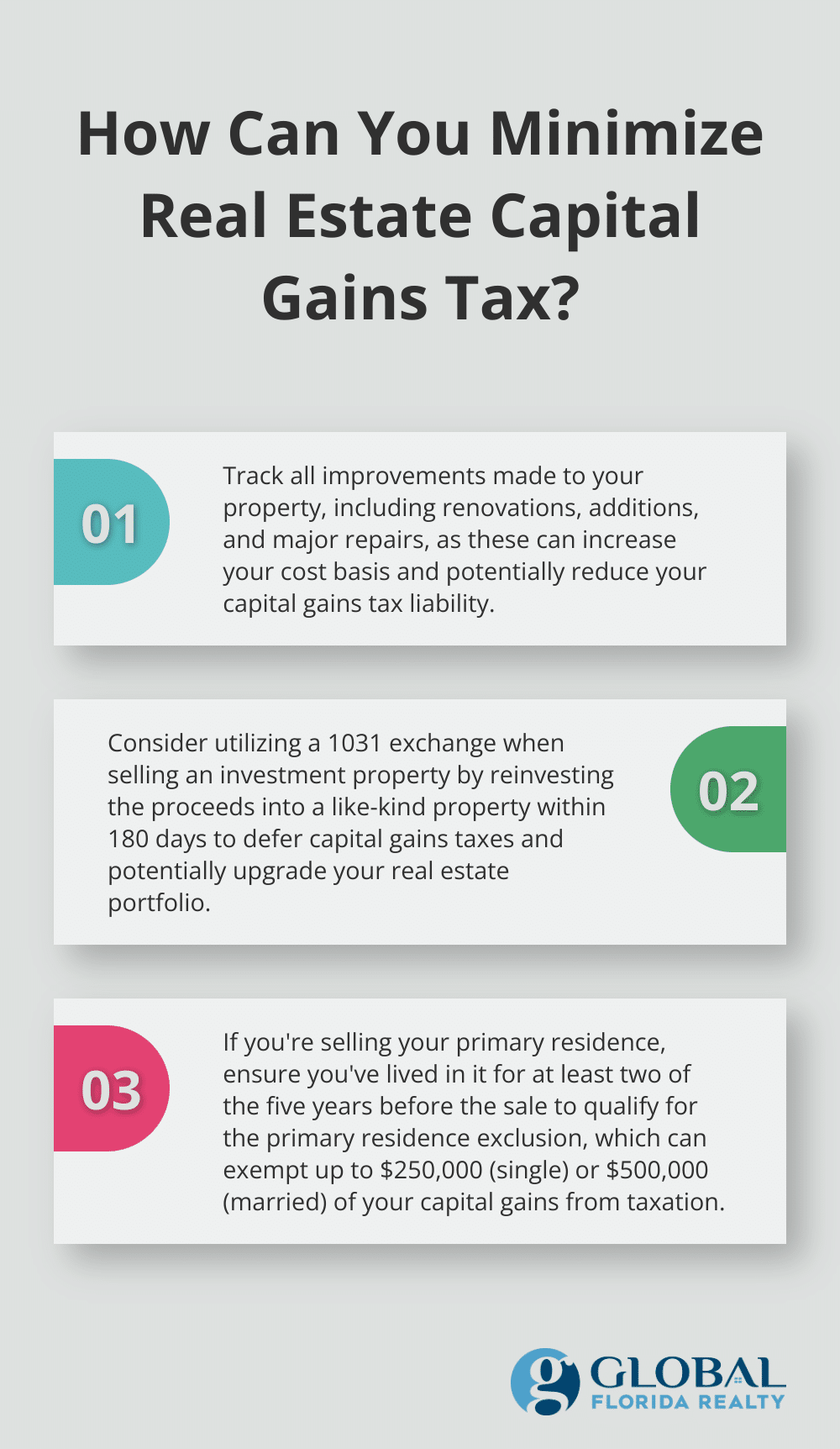
The primary residence exclusion offers a significant tax benefit for homeowners. If you meet certain conditions, you may exclude the first $250,000 of gain from the sale of your home from your income and avoid paying taxes on it. This exclusion can substantially reduce (or even eliminate) your tax liability on the sale of your primary residence. Many homeowners consider this exclusion when planning to sell their homes.
Investment properties follow different rules. While you can’t use the primary residence exclusion, you might defer your capital gains tax through a 1031 exchange. This strategy allows you to exchange investment properties and defer capital gains taxes.
Understanding these nuances of capital gains tax in Florida real estate can significantly influence your investment decisions and overall returns. It’s wise to consult with a tax professional and a knowledgeable real estate agent (such as those at Global Florida Realty) to navigate these complex waters effectively. In the next section, we’ll explore strategies to minimize your capital gains tax liability and maximize your real estate investments in Florida.
The first step in calculating capital gains involves determining your property’s cost basis. This includes:

For instance, a house in Tampa bought for $300,000 with $5,000 in closing costs and fees would have an initial cost basis of $305,000.
Property improvements can increase your cost basis, potentially reducing your capital gains. Eligible improvements include:
Maintain detailed records of these improvements, as the IRS may require documentation during an audit.
When selling your property, certain costs can be deducted from your sale price:
Once you have your adjusted cost basis and net sale price, you can calculate your capital gain. Here’s an example:
Original purchase price: $300,000
Closing costs at purchase: $5,000
Home improvements: $50,000
Adjusted cost basis: $355,000
Sale price: $500,000
Selling costs: $30,000
Net sale price: $470,000
Capital gain: $470,000 – $355,000 = $115,000
This $115,000 would be subject to federal capital gains tax rates. As of 2025, the long-term capital gains tax rate is 20% for individuals with taxable income of $533,401 or more.
Precise capital gains calculations serve several purposes:
For complex transactions, consulting with a tax professional can provide valuable insights. While real estate agents offer expert property services, tax laws can be intricate and subject to change. A qualified tax advisor can help you optimize your real estate investments while maintaining compliance with current tax regulations.
In the next section, we’ll explore strategies to minimize your capital gains tax liability, helping you retain more of your real estate profits.
The primary residence exclusion offers homeowners a significant tax advantage. Residents who own property and make it their permanent residence may be eligible for a property tax break of up to $50,000 through Florida’s homestead exemption. To qualify, you must have lived in the home for at least two of the five years before selling.

For example, a married couple who bought an Orlando home for $300,000 and sold it for $700,000 after living in it for three years could potentially benefit from this exemption.
Investors can defer capital gains taxes through 1031 exchanges by reinvesting proceeds from a property sale into a like-kind property. This strategy allows real estate investors to upgrade their portfolio without immediate tax liabilities.
The Section 1031 Like-Kind Exchange allows exchange transactions to incur limited tax liability, highlighting the strategy’s popularity among investors.
The timing of your property sale can significantly impact your tax liability. Holding a property for more than a year qualifies you for long-term capital gains rates (which are generally lower than short-term rates). As of 2025, long-term capital gains rates range from 0% to 20%, depending on your income bracket.
You might consider selling during a lower income year or near retirement to potentially place yourself in a lower tax bracket, thus reducing your overall tax burden.
Qualified Opportunity Zones provide substantial tax benefits for investors. Florida boasts 427 designated opportunity zones, offering investors the chance to defer and potentially reduce capital gains taxes by reinvesting in these economically distressed communities.
If you sell a property and reinvest the capital gains into an Opportunity Zone Fund within 180 days, you can defer the tax until 2026. Moreover, if you hold the investment for at least 10 years, you may qualify for a complete exemption from capital gains tax on the appreciation of your Opportunity Zone investment.
While these strategies can effectively reduce capital gains tax, their implementation requires careful planning and expert guidance. Global Florida Realty specializes in identifying prime real estate opportunities, but we always recommend consulting with a qualified tax professional to ensure you maximize your tax benefits while staying compliant with current regulations.
Florida capital gains tax on real estate involves complex federal tax laws and strategic planning. Property owners must navigate federal capital gains taxes, despite Florida’s lack of state income tax. The primary residence exclusion, 1031 exchanges, and opportunity zone investments offer powerful tools to minimize tax liabilities.
Accurate calculation of capital gains and strategic timing of property sales play vital roles in reducing tax burdens. Holding properties for longer periods and selling during lower-income years can result in more favorable long-term capital gains rates. Professional guidance becomes essential when dealing with these intricate aspects of real estate transactions.
Global Florida Realty offers expertise in Florida’s real estate market, covering buying, selling, and investing in desirable areas. Their services include locating personal homes and managing investment properties (including vacation rentals near popular attractions). Collaboration with tax professionals ensures optimal real estate investments while maintaining compliance with current regulations.